The world of violins is steeped in history and tradition, with each instrument holding its own unique story. One such story is that of Jean-Auguste Darte and the Stentor violins he produced.
Nicolas Vuillaume (brother of J.B. Vuillaume) married Darte’s mother, Rosalie Zoegger, in 1839 thus becoming Jean Auguste’s stepfather. Darte was born in Paris and began his apprenticeship under Nicolas Vuillaume in Mirecourt. He eventually went to J.B. Vuillaume’s workshop in Paris before returning to Mirecourt to work as Nicolas’s assistant. In 1865, he took over the Nicolas Vuillaume workshop and continued the production of Stentor violins before eventually selling the brand to the firm of Gautrot.
Stentor violins were made on a Guarneri model and were available in three different qualities, according to Bernard Millant. Some have remarked that they were called “the God of coffee” due to their supposed coffee-coloured varnish. However, despite many examples being examined, this description has yet to fit this description truly. Some speculate that the real reason behind the name may be a pun on the name of Darte’s son-in-law, Francois Charles Coffe.
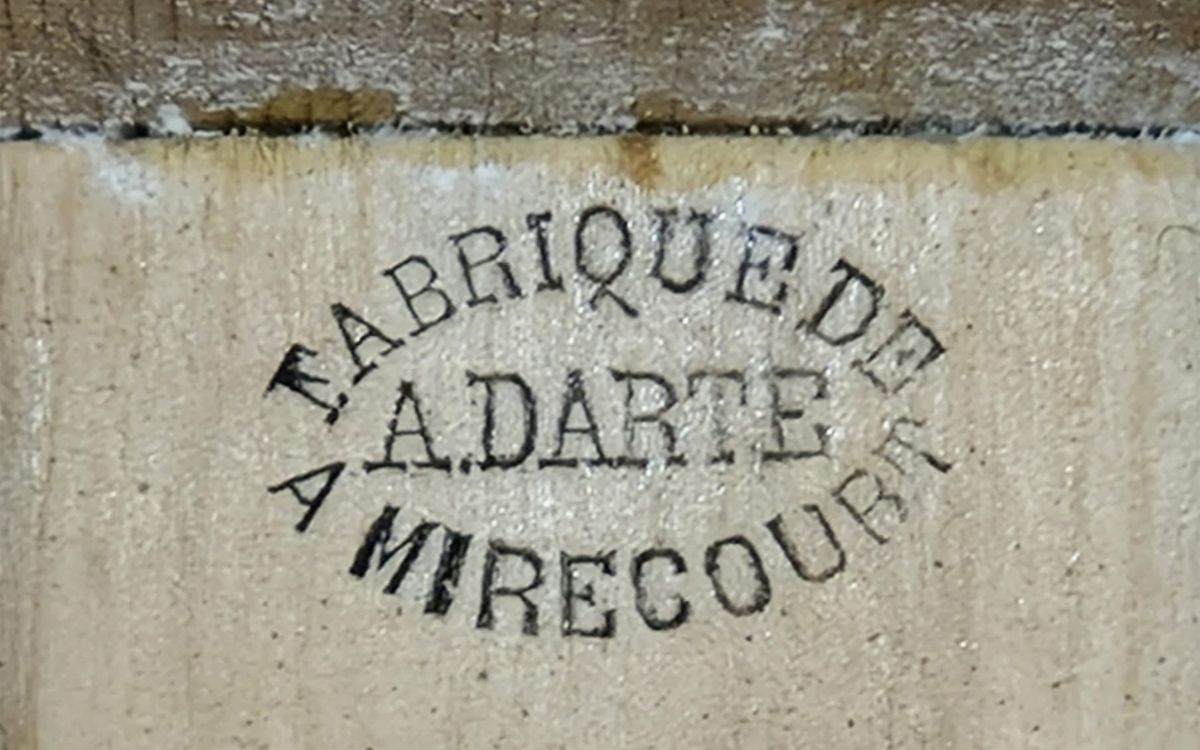
Despite the mystery behind the name, Stentor violins continue to hold a place in the world of music as well-crafted instruments. The ¾ size example we currently have for sale bears Darte’s brand to the top block as well as the familiar shield to the back of the scroll, the perfect student instrument for a promising young player.
Today, Darte’s legacy lives on through his violins, each one a testament to his dedication and passion for the craft. Aspiring young musicians can still find inspiration in the story of Jean Auguste Darte and the Stentor violins he produced, reminding us that even in a world of constantly evolving technology, the beauty and power of music remain timeless.
